

If you’re buying or selling link insertions in 2026, anchor text is the one detail that quietly decides whether a placement helps your rankings or triggers a manual action. Most guides talk about domain rating and traffic, but the anchor text you attach to a niche edit is what Google actually reads as a signal of intent. Get the ratio wrong across a handful of insertions and you’ve built a pattern that’s easy for an algorithm (or a human reviewer) to spot.
Here’s how we think about anchor text for every link insertion we place, the ratios that keep a link profile looking natural, and a short checklist you can run before you buy your next niche edit.
What Is Anchor Text, and Why Does It Matter More in Link Insertions? 🔗
Anchor text is simply the clickable words that carry a link — the phrase a reader sees underlined or highlighted. Search engines use it as a small piece of context about the page on the other end of that link. As Ahrefs explains in its anchor text glossary, it’s one of hundreds of ranking signals, but it’s also one of the few that a webmaster can control directly — which is exactly why Google pays closer attention to it.
With guest posts, the anchor text usually sits inside content written specifically for the campaign, so it can look a little more “designed.” With link insertions (niche edits), the link is dropped into an already-published, already-indexed article. That makes the anchor choice more exposed: it has to fit naturally into a sentence someone else wrote, and it has to make sense to a reader who has no idea you’re building a backlink at all.
The 5 Types of Anchor Text You’ll See in Niche Edits
- Branded — your company or product name (e.g. “LinkInsertion.io”). Safest option and the backbone of a natural profile.
- Naked URL — the raw link (e.g. “linkinsertion.io”). Reads as organic and journalistic, which is exactly how real citations look.
- Generic — phrases like “this guide,” “learn more,” or “read the full breakdown.” Low risk, blends into any sentence.
- Partial-match — a phrase related to your target keyword without being an exact copy (e.g. “a guide to niche edits” instead of “link insertion services”). Useful, but should be varied.
- Exact-match — your precise target keyword as the anchor. The most powerful for rankings, and the riskiest when overused — this is the one that needs the tightest budget.
What’s a Safe Anchor Text Ratio in 2026? 📊
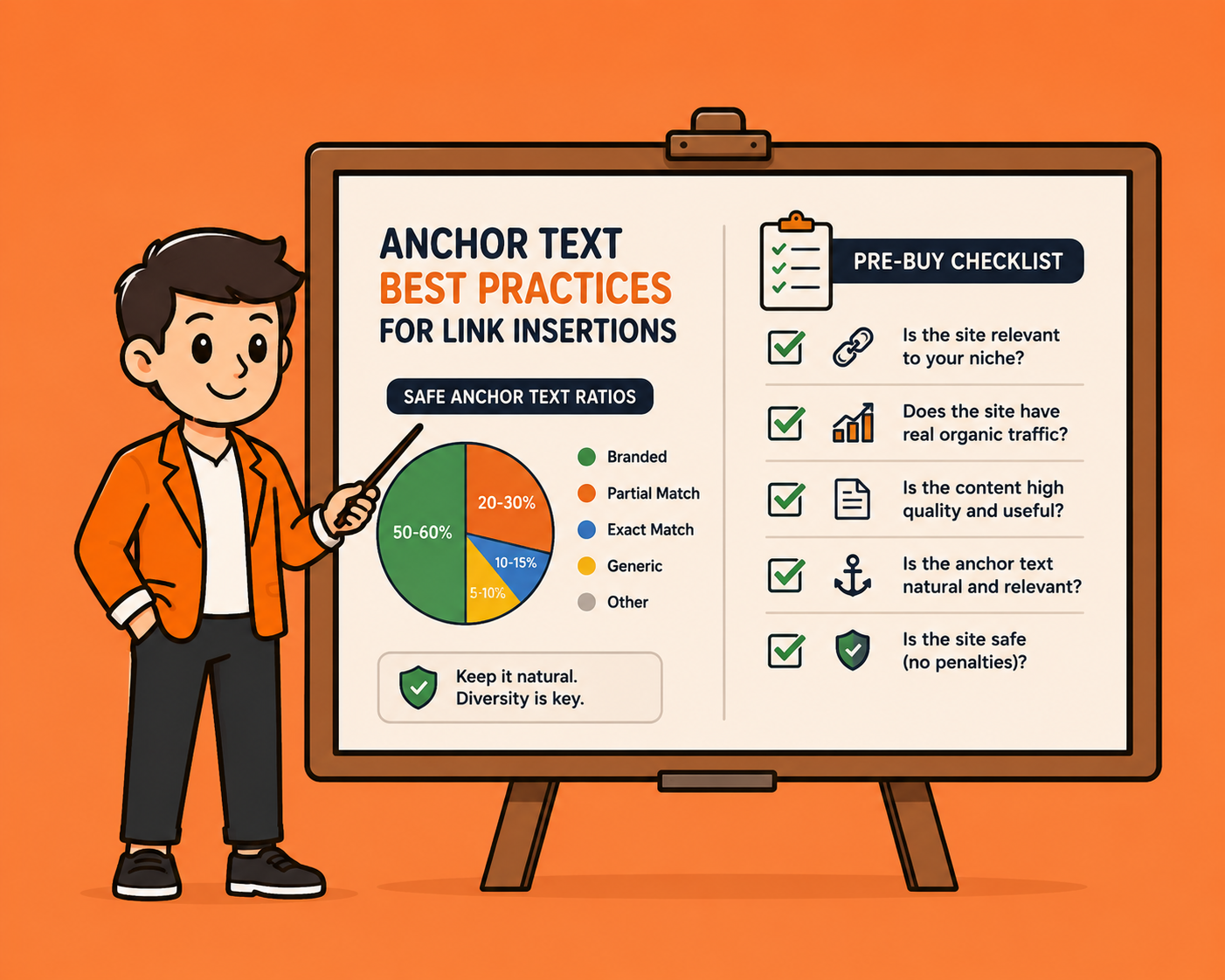
There’s no single ratio Google publishes, but years of link building data and post-penalty recoveries point to a pattern that keeps profiles looking earned rather than engineered. As a rough, general-purpose split across a full backlink profile (not just your insertions), we aim for something close to:
- 40–50% branded and naked URL anchors
- 20–30% generic anchors (“click here,” “this resource”)
- 15–25% partial-match anchors
- Under 10% exact-match anchors
Google’s own spam policies specifically call out link schemes that use “optimized anchor text in articles” as manipulative, so the goal with every niche edit is to make each individual anchor look like something a normal editor would have written — and to look at the ratio across your whole profile, not just the last five links you bought.
5 Anchor Text Mistakes We See in Link Insertion Campaigns ⚠️
- The same exact-match anchor, repeated across every placement. This is the single fastest way to build a pattern Google can flag.
- Anchor text that doesn’t match the sentence around it. If the paragraph is about kitchen renovations and the anchor is “best project management software,” it reads as inserted — because it was.
- Stuffing two or three links into one paragraph. A single, well-placed link almost always outperforms a cluster that looks like a link farm.
- Ignoring the page’s existing link profile. A brand-new blog post with one outbound link to your money page (and nothing else) is a red flag to anyone auditing the site.
- Treating anchor text as an afterthought. Vendors who let you pick any anchor, on any page, with no pushback, usually aren’t thinking about your link profile at all — only the sale.
How We Choose Anchor Text for Every Link Insertion
Before we place a link, we look at your existing anchor text distribution, not just the page we’re pitching to. If your profile is already exact-match heavy, we’ll push you toward branded or generic anchors even if you’d prefer the “perfect” keyword — a strong backlink profile is a balanced one, and short-term keyword gains aren’t worth a manual action six months later. The same discipline applies across every channel we use to secure links, including our HARO link insertion service, where anchors are negotiated with journalists rather than picked freely.
If an anchor wouldn’t survive a human editor reading the sentence out loud, it won’t survive a spam review either.
Quick Pre-Buy Checklist ✅
Before you approve an anchor for your next niche edit, run it through this list:
- Does the anchor read naturally inside the surrounding sentence?
- Have you used this exact anchor on more than 1–2 other placements this quarter?
- Is the linking page topically related to your target page?
- Would you be comfortable explaining this placement to Google in a reconsideration request?
- Is this the only link being inserted into the article, or is it being stacked with others?
Frequently Asked Questions
Does anchor text still matter in 2026?
Yes. Google’s algorithms and manual spam reviews both still weigh anchor text as a signal, and an unnatural anchor pattern remains one of the most common reasons a backlink profile gets flagged.
What anchor text ratio is safe for link insertions specifically?
The same general ratio applies to niche edits as to any other link type — lean heavily on branded, naked URL, and generic anchors, and keep exact-match anchors under about 10% of your total profile.
Can bad anchor text alone cause a Google penalty?
On its own, rarely — it’s usually one part of a broader pattern (low-quality linking domains, irrelevant placements, paid link schemes). But an unnatural anchor ratio is often the first thing that draws a reviewer’s attention to the rest of the profile.
Should I ever use exact-match anchors for a link insertion?
In moderation, yes. A small number of well-placed exact-match anchors on genuinely relevant pages is normal. The problem isn’t using them — it’s using them as your default choice on every placement.
Anchor text is a small detail with an outsized effect on how safe your link building really is. If you’d rather have that judgment call made by people who track it across every campaign, get in touch with our team and we’ll walk you through how we’d approach your specific link profile.